
Integrated Trade Show Marketing
Updated: Sep 27

Integrated Trade Show Marketing
by Larry Kulchawik
When I was the VP of Sales & Marketing for Greyhound Exhibit group,I was asked the question “What’s the difference between sales and marketing? My definition of marketing vs. sales: “Anything you do to support a selling situation is marketing.” Upgrading to first class and sit next to a fellow business traveler is a marketing strategy. It is common to strike up a discussion with a fellow passenger that leads to “So, what do you do?” Most first-class travelers are business people, so the topic of marketing often is understood. This brief face-to-face encounter can be very powerful, and the element of emotion kicks in to carry harmless small talk (a marketing situation) to a selling situation very quickly. Your seat mate may not be involved directly in marketing, but rest assured they will pass along your business card to a person who is.
Many different attention getting strategies can serve to create a “selling situation.” But caution- do not start selling until the telling has been done objectively and the buyer exclaims- tell me more. It is now that selling begins. This is now a selling situation.
Before trade shows, one of the earliest forms of live selling in America was the Patent Medicine Show. Hucksters promoting potions and lotions from the back
of small wagons. They always provided an entertaining bit of shitck to gather a crowd before they launched into their pitch.
Trade show marketing guru Fred Kitzing would say- “Its not the exhibit, but an attraction that encourages a trade show visitor to stop and observe. It is now that human contact will be accepted to begin a dialog.
Freds wife, Llona Kitzing, conceived the concept of integrated trade show marketing. This concept has now been embraced by marketing managers, exhibit
designers, and trade show industry associations.
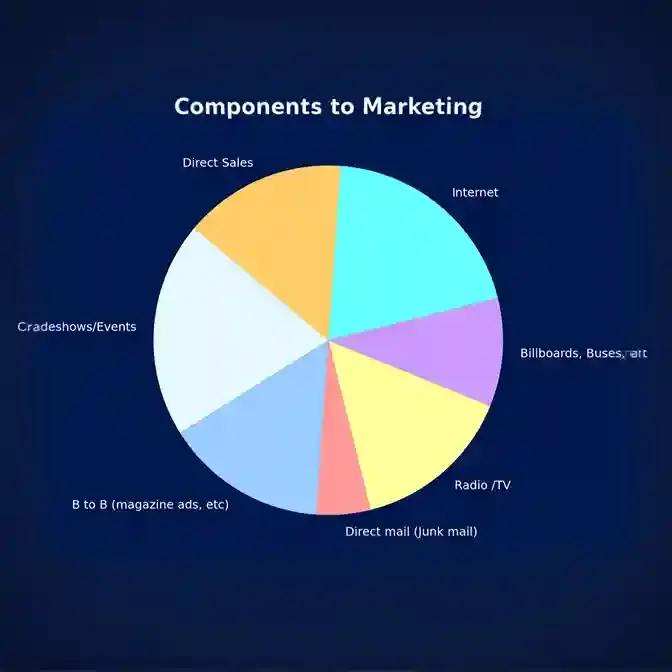
According to Llona, there are seven major components to marketing. The rule of thumb for exhibiting companies planning a budget for trade shows, is that 5 percent of their business revenue should be earmarked for marketing. This of course depends on the business you are in. A consumer product company would spend more than a machine tool company, so 5 percent is a fair starting figure. This 5 percent marketing budget is then divided among the seven components in the mix to then collectively support a specific marketing strategy. Each component is not independent of the other. Each component must be integrated to compliment a single marketing goal.
The pie chart illustrates a likely assessment for many companies. For many companies, the trade show/event portion of the budget will be the biggest cost. With that said, measuring the impact of the trade show with other marketing components, is key to continuing this investment activity. It’s not about the exhibit structure, but what the structure is doing to enhance a message and reach a targeted audience, according to Llona Kitzing.
When setting a marketing budget, no one component of the seven is more important than the other. The formula for which components you combine is up to you with each working to compliment the other. The mix together creates an integrated marketing strategy.
Collectively, all components should contribute to creating a selling situation. In some cases, when an exhibit visitor knows exactly what they really need, human contact may not be needed. For example, shopping through the Internet to buy a commodity like a watch, an appliance, or a set of golf clubs, can work just fine and can be less time consuming, provided you know exactly what you are buying and their relative value. But when you are uncertain what you need or expect to receive, human contact is a powerful tool to influence your decision to buy.
Of all the seven marketing strategies, only two components require eye–to-eye contact where emotion comes into play—direct sales and trade shows. Of all the seven components, trade shows will be the greatest expense, but can deliver the greatest return when executed correctly. It must be noted that without the support from each of the other marketing components, this human-contact element would be minimal if starting from scratch in the selling process. Trade show marketing can be very expensive, but the return can be greater if all the components are integrated to work in harmony.
Yes, trade show marketing is expensive but doing it right is one thing, but measuring the results of each trade show is equally critical if you expect your marketing budget to be approved the same for each year.


Comments